
Lewis Carroll, the whimsical mastermind behind “Alice’s Adventures in Wonderland,” invites readers into a world where logic takes a holiday and nonsense reigns supreme. With a pen as sharp as a Cheshire Cat’s grin, he crafted tales that tickle the imagination and challenge the mind. But Carroll wasn’t just a writer; he was a mathematician, a photographer, and a dreamer who saw the extraordinary in the ordinary.
Overview of Lewis Carroll
Lewis Carroll, born Charles Lutwidge Dodgson in 1832, is best recognized for his contributions to literature, particularly “Alice’s Adventures in Wonderland” and its sequel, “Through the Looking-Glass.” These works showcase his skill in blending fantasy with everyday experiences. Originating from England, Carroll became known for his unique writing style, characterized by playful language and imaginative storytelling.
Mathematics also played a significant role in Carroll’s life. He worked as a lecturer in mathematics at Christ Church, Oxford, where he explored logic and symbolic reasoning. Carroll’s passion for mathematics influenced his literary creations, often incorporating mathematical concepts into his narratives.
Photography was another of Carroll’s talents. He embraced the medium as art, taking numerous portraits of children and family members. His photography often reflected his whimsical perspective on life, capturing moments that seemed ordinary yet extraordinary when viewed through his lens.
In his stories, Carroll tackled themes like identity and transformation, allowing readers to explore their own realities. The characters, such as the Cheshire Cat and the Mad Hatter, embody the nonsensical nature of his worlds while prompting deeper reflections on societal norms.
Through his multifaceted genius, Lewis Carroll continues to captivate audiences. His ability to intertwine logic with fantasy offers a unique lens on both literature and life, engaging generations of readers. Each layer of his work reveals not just a fantastical realm but also insights into the human experience.
Early Life and Education
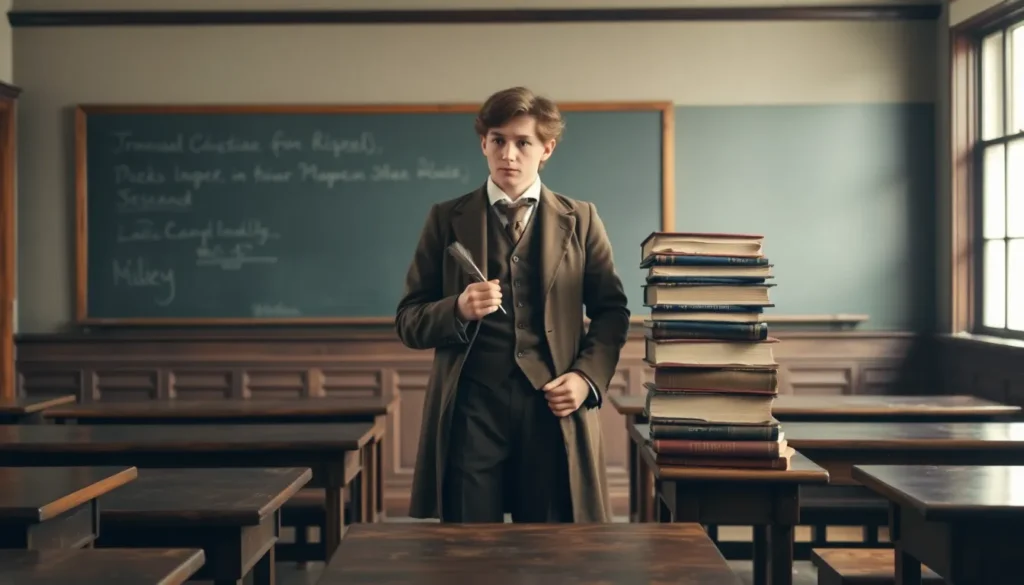
Lewis Carroll, born Charles Lutwidge Dodgson, had an intriguing early life that shaped his creative endeavors. He hailed from a large family, which included his father, a prominent Anglican clergyman.
Family Background
Carroll’s family consisted of eleven siblings. His father, Charles Dodgson, served as the rural dean of Daresbury, while his mother, Frances Jane Lutwidge, was the daughter of a local landowner. With such a diverse household, storytelling likely became a natural pastime. The influence of his family’s literary pursuits played a vital role in nurturing his imagination. Carroll’s early exposure to literature and storytelling sparked his passion for writing from a young age.
Academic Pursuits
At age 12, Carroll enrolled at Richmond Grammar School. He then progressed to Christ Church, Oxford, in 1850. There, he excelled in mathematics, earning a first-class degree in 1854. His fascination with logic fueled his academic interests, leading him to become a mathematics lecturer at Christ Church. Carroll often integrated mathematical concepts into his writings. His unique blend of academia and creativity became evident through his narratives, captivating readers with logical puzzles intertwined in whimsical storytelling.
Literary Career
Lewis Carroll’s literary career includes a remarkable collection of works that blend imagination with logic. His most famous creations are “Alice’s Adventures in Wonderland” and “Through the Looking-Glass.” Both stories feature whimsical characters and surreal scenarios, engaging readers of all ages. Other notable works include “The Hunting of the Snark” and “Sylvie and Bruno,” which showcase his unique narrative style and inventive use of language.
Major Works
“Alice’s Adventures in Wonderland” was published in 1865, immediately capturing the public’s attention. Through playful language and absurdity, it challenges readers’ perceptions of reality. The sequel, “Through the Looking-Glass,” released in 1871, further explores themes of duality and transformation. “The Hunting of the Snark,” a nonsense poem from 1876, showcases Carroll’s fascination with language and structure. Each work demonstrates his innovative storytelling ability and his talent for combining fantasy with life lessons.
Influence on Literature
Carroll’s influence on literature stretches far beyond his own writings. He inspired a range of authors, including J.M. Barrie and C.S. Lewis, who adopted similar whimsical styles. Fantasy literature owes much to his imaginative narratives, as do children’s books that embrace elements of nonsense. Themes of identity and transformation, introduced through characters and settings, resonate in numerous contemporary works. Writers today still find inspiration in Carroll’s playful use of language and profound observations about society.
Themes and Styles
Lewis Carroll’s work contains rich themes and distinct styles that uncover deeper meanings beneath whimsical surfaces.
Nonsense Literature
Nonsense literature serves as a hallmark of Carroll’s writing. It breaks conventional logic, creating a playful atmosphere filled with absurd characters and language. The use of nonsensical phrases and situations captivates readers, inviting them to embrace imagination unbound by reality. Examples include the riddle of the Jabberwock and the nonsensical dialogue between Alice and the Red Queen. These elements challenge traditional storytelling norms and encourage critical thinking. Carroll’s approach to nonsense not only entertains but also prompts readers to explore the limits of language and logic.
Fantasy and Imagination
Fantasy and imagination play pivotal roles in Carroll’s stories. Magical landscapes populate his narratives, such as the enchanting Wonderland and the curious realm of the Looking-Glass. Characters like the Mad Hatter and the Cheshire Cat embody whimsical traits that transform mundane experiences into extraordinary adventures. Through vivid descriptions, Carroll immerses readers in fantastical worlds, allowing them to escape limitations of everyday life. Each story combines surreal elements with imaginative situations, highlighting the power of creativity. Such unique storytelling inspires readers to cherish their own imaginations, leaving a lasting impact on the genre of children’s literature.
Legacy and Impact
Lewis Carroll’s legacy extends far beyond his well-known literary works. His innovative narratives and playful use of language have shaped children’s literature profoundly. Readers continue to explore the whimsical worlds he created, where nonsense and logic intertwine seamlessly.
Influence can be seen in the works of authors such as J.M. Barrie and C.S. Lewis. Both writers drew inspiration from Carroll’s unique ability to blend fantasy with reality. His exploration of identity and transformation through characters like the Cheshire Cat remains relevant, prompting ongoing discussions about societal norms.
Critics and scholars frequently analyze Carroll’s hallmark nonsense literature, which breaks the conventional boundaries of storytelling. His stories invite readers to engage in critical thinking while navigating the absurdities of life. Themes of imagination and adventure resonate in modern literature, illustrating Carroll’s lasting impact.
Furthermore, academic circles recognize Carroll’s contributions to logic and mathematics. His background as a lecturer at Christ Church, Oxford, allowed him to incorporate complex ideas into his writing. The interplay between mathematics and storytelling reveals a multi-dimensional approach to creativity.
Cinematic adaptations of his works have also expanded his reach, introducing new audiences to his fantastical tales. Film and theater interpretations keep the essence of his stories alive while engaging creativity in diverse formats. As a result, his influence continues to permeate various art forms, ensuring that Lewis Carroll’s genius remains celebrated and cherished.
Conclusion
Lewis Carroll’s legacy endures as a testament to the power of imagination and the intricacies of logic. His ability to weave whimsical tales that challenge conventional thinking has left an indelible mark on literature and beyond. Through his unique blend of fantasy and reason, he not only entertained but also encouraged readers to explore deeper meanings in their own lives. Carroll’s influence continues to resonate in modern storytelling, inspiring new generations to embrace creativity and critical thought. As both a literary and mathematical mind, he remains a figure of fascination, ensuring that his work will be celebrated for years to come.